
Snooker 'deliberate foul' controversy grows as questions raised over unwritten code of conduct

Recent incidents on the World Snooker Tour have brought into question ‘fair play’ and the sport’s ‘unwritten code of conduct’.
Debate continues to rumble on about ‘deliberate fouls’ in snooker, with opinion divided online.
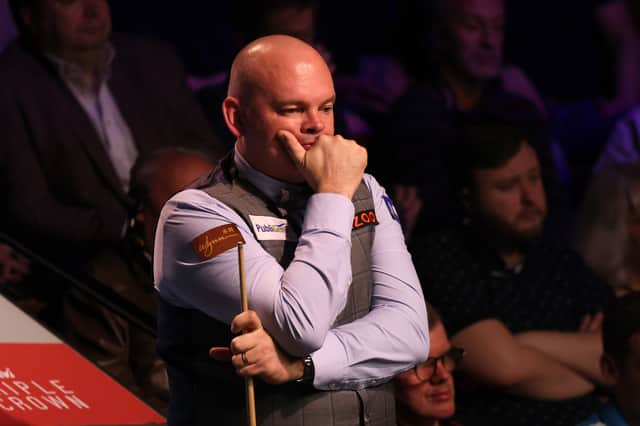

At the recent 2026 China Open in Taiyuan, an incident in a last 16 match between Stuart Bingham and Hossein Vafaei went viral amongst the snooker community.
In frame five of their encounter, Vafaei - who was 4-0 down in frames and 60-8 behind in points at the time - found himself in a difficult position with the cueball on the baulk cushion, and only able to directly hit one red that was near a cushion by a middle pocket.
Vafaei played thin off that red, but the cueball immediately went in-off. Bingham received four penalty points and cueball in hand from the ‘D’ area, but the red Vafaei had played ran safe, and Bingham had no straightforward pot on any of the remaining reds.
In what turned out to be a very favourable outcome for Vafaei - although he eventually went on to lose the match 6-0 - an angered Bingham accused his opponent of deliberately sending the cueball in-off to get out of trouble, remonstrating this to him and the referee in the arena.
Whether this was Vafaei’s intention or not - he responded to Bingham by saying that he was trying to play the cueball back to a safe area - no rule had been broken, so play continued as normal.
Following his exit from the £1.2 million ranking event - during which he enjoyed a deep run to the semi-finals - 2015 World Champion Bingham took to social media to express his views on the incident. Whilst he acknowledged it wasn’t an illegal shot, he felt that it wasn’t ‘in the spirit of the game’ and it needed calling out there and then, instead of after the match.
Is there such a thing as a ‘deliberate foul’ in snooker?
There have been a few examples in recent months on the professional circuit when a player has seemingly played a ‘deliberate foul’.
At the 2026 British Open qualifiers a few weeks ago, Oliver Lines was furious when his opponent Xu Yichen allegedly used the yellow (the ball on) to pot the brown that it was right next to and dangling over a corner pocket.
Lines needed multiple snookers at the time, so would have welcomed the four penalty points he received, but clearly did not appreciate Xu’s shot choice.
At the World Championship earlier this year, during the infamous ‘longest Crucible Theatre frame ever’ in the semi-final between Wu Yize and Mark Allen, Allen deliberately knocked in the black that had been blocking the corner pocket to resolve the protracted stalemate between the two players - it had been 56 minutes since the last pot.
This situation is different to the two mentioned before; Allen - who was 34 points ahead at the time - didn’t really have another choice, although he did play a deliberate foul and tried to leave the balls safe in order to later win the frame.
On a recent episode of the Snooker Hall Podcast (recorded before the Bingham-Vafaei match) one of the world’s top referees, Tatiana Woollaston, was asked about ‘deliberate fouls’ in the sport.
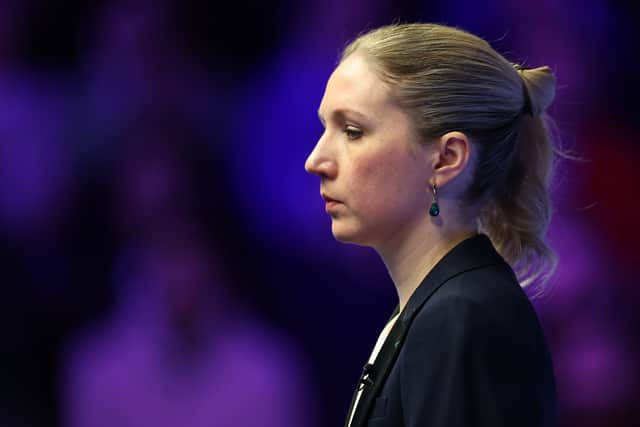
The former UK Championship and Masters final referee said: “There is no such thing as a deliberate foul in the rule book, because you can't prove it.”
Woollaston went further, explaining in such examples that if a player successfully contacts the ball on, it’s a legal shot; they didn’t deliberately hit an illegal ball first, nor have they missed all the balls together, both of which would result in a ‘foul and a miss’ being called.
"I guarantee 90% of the tour players at some point played off the pack in-off.... because they didn't have a path back to the baulk” added Woollaston. “So they're thinking 'I would rather give the four points away than leave him amongst the balls'.
“That, in theory is a deliberate foul, because they're actually playing to go in-off, but there is no such thing as a deliberate foul.
“They've hit the red, it's a legal shot, also they went in-off, foul four points. Because it's all interpretation, it can't be included in the rules. You can not prove it.”
Professional player suggests unwritten code of conduct is not being abided to
On a recent episode of the World Snooker Tour’s Snooker Club Podcast - which stars Stephen Hendry - current professional player Steven Hallworth discussed the Bingham-Vafaei flashpoint, and the general topic of deliberate fouls in the sport.
"I've seen this a couple of times in the past few weeks actually. In the qualifiers, my friend Oliver Lines was on the receiving end of one of the most outrageous things I've ever seen on a snooker table. But the rule allows for it. It's a loophole in the system” said the world number 74.
Former English Amateur Snooker Champion Hallworth even sought advice from former World Championship final referee Leo Scullion, and was surprised to learn that a deliberate foul does not exist in the rulebook, but feels it is something that players themselves should be thinking about in relation to an ‘unwritten code of conduct’ they have.
“I spoke to Leo Scullion at the qualifiers regarding it because I was under the impression that there was such a thing as a deliberate foul - there isn't, and he said that it would take a very strong referee to stand up and acknowledge that as being against the spirit of the game.
“There's a bit of an unwritten conduct rule amongst players and I think at times it's not been abided to. Not saying Hossein has done anything wrong there because he hasn't, he's played a shot, but in the spirit of the game, it wasn't good to see, but the rule allows for it, so there's arguments on both sides.”