
How can you make a break bigger than 147 in snooker? Ronnie O'Sullivan world record feat explained

Ronnie O’Sullivan’s bulky career résumé is covered in records and first, and on Friday at the World Open in China, he produced yet another feat of green baize excellence.
The seven-time world champion constructed the highest break ever made in professional snooker competition history with an extraordinary effort of 153 during the first frame of his quarter-final match against Ryan Day at the Yushan Sports Centre.

‘The Rocket’ would go on to rack up two further centuries in a 5-0 whitewash win; he’ll face Wu Yize on Saturday (from 06:00GMT) in the semi-finals of the £825,000 world ranking event.
Before today, only once before had a break of over 147 been compiled on the top-flight snooker circuit.
That was an effort of 148 by Scotland’s Jamie Burnett during the 14th frame of his 2004 UK Championship second qualifying round match against Leo Fernandez at Pontin’s Prestatyn. Unfortunately, there is no footage of that achievement - it wasn’t televised, or streamed.
Therefore, O’Sullivan’s sequence in the Far East is the first televised break of over 147, and a new world record for being the highest overall.
Every single point of Ronnie O'Sullivan's RECORD-BREAKING 153! 🤯#WorldOpen pic.twitter.com/SsxtTDaylL
— WST (@WeAreWST) March 20, 2026
What is a freeball in snooker? How to make more than a 147
Many casual sports can be forgiven for asking how this is even possible, as a 147 break is often seen as snooker’s break-building pinnacle.
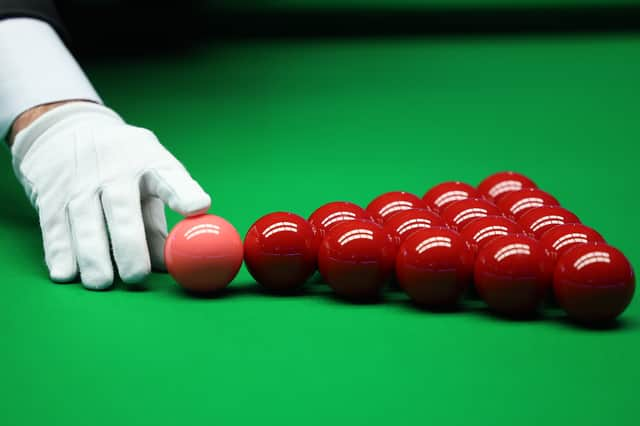
The only way a player can make a break higher than a 147 is through the use of a ‘freeball’ at the start of a break before any of the 15 red balls have been potted.
In O’Sullivan’s case, his opponent Day was snookered on all the reds, behind the green ball. Attempting to escape the snooker with a thin clip and leave it safe, Day missed, and the cueball travelled back into the baulk area.
The cueball ended in a position where O’Sullivan could not hit both sides of any of the 15 reds at the other end of the table, therefore a ‘freeball’ was awarded to him by the referee.
In a freeball situation, a player can then nominate and play one of the other colours on the table, which then ‘becomes’ the original colour on. This essentially is an extra bonus ball carrying the same points value as the original ball they should have been on.
So, O’Sullivan elected to pot the green ball - which he did - and this green essentially became a red, therefore he was given one point. The green got re-spotted, and for the rest of the break it was worth its natural three points.
As the green was a red for that shot, O’Sullivan then needed to pot a ‘colour’ to keep the break going, as per normal snooker rules. He sank the black, so the break moved on to eight, with all 15 reds still left on the table.
The 50-year-old then went about potting 13 ‘normal’ reds, all with blacks. When potting the 14th normal red, he nudged the black near the top cushion, therefore decided to take the pink to keep the break going.
He then sank the last red with another pink, and then all the six colours - including a pressure black along the rail for a unprecedented 153.
Technically, the highest possible break in snooker is a 155 - a freeball red followed by a black, then all 15 reds with blacks, and then all six colours. In total, O’Sullivan potted 16 reds (when including the freeball on the green), 14 blacks, 2 pinks, and all the colours.
Marco Fu became just the seventh player ever to land a "16-red" total clearance at World Championship qualifying last year! 🔴 pic.twitter.com/dFvOIcsJOs
— WST (@WeAreWST) March 14, 2026
How many 16-red total clearances have there been in snooker?
It is so rare for a player to be awarded to a freeball towards the start of the frame because there are so many reds available on the table, but it does happen.
Whilst there have now been two breaks of over 147 in top tier snooker competition - with O’Sullivan setting a new benchmark - there have been eight instances of a 16-red total clearance (starting the break with a freeball red) in professional play.
The first example of this actually came at the Crucible Theatre during the 1990 World Snooker Championship when Steve James compiled a 135 break during his opening round match against Alex Higgins.
153 - Ronnie O’Sullivan (2026 World Open)
148 - Jamie Burnett (2004 UK Championship)
141 - Ricky Walden (2008 UK Championship)
141 - Mark Selby (2018 China Open)
140 - Liam Highfield (2020 Scottish Open)
139 - Ryan Day (2023 Tour Championship)
139 - Marco Fu (2025 World Championship)
135 - Steve James (1990 World Championship)
(List correct as of 20/03/2026)
Ryan Day - who had the best seat in the house for O’Sulivan’s 153 - is also on this list for a 139 he made at the 2023 Tour Championship. During the same match, Welshman Day also had a maximum 147!
Will we ever see a total maximum break of 155 in professional snooker? Well, O’Sullivan’s astonishing contribution was the closest we’ve ever come. He was on course for it until the black got pushed into an awkward position after potting the penultimate red.
Getting a 155 is out of a player’s hands to start with, as they require their opponent to foul, leave a freeball situation on, and a freeball available to pot. That is a rare scenario as it is, without making a 147 on top of that - all the stars would need to be aligned.
Of course, nowadays, the Riyadh Season Snooker Championship has an extra golden ball attached worth 20 additional points - this can be potted after a player makes a 147, so there is a 167 ‘golden maximum’ available, and along with it comes a $1 million bonus.
However, no-one has unlocked this prize (it was $500,000 for the inaugural edition) during the first three stagings of the tournament held in Saudi Arabia.
Technically, a 175 could be made in that event with a freeball to start with!
To view the full draw, results, schedule, and other information from the 2026 World Open, visit here.